H.E. Tan Sri Muhammad Shahrul Ikram Yaakob
Ambassador of Malaysia to the United States
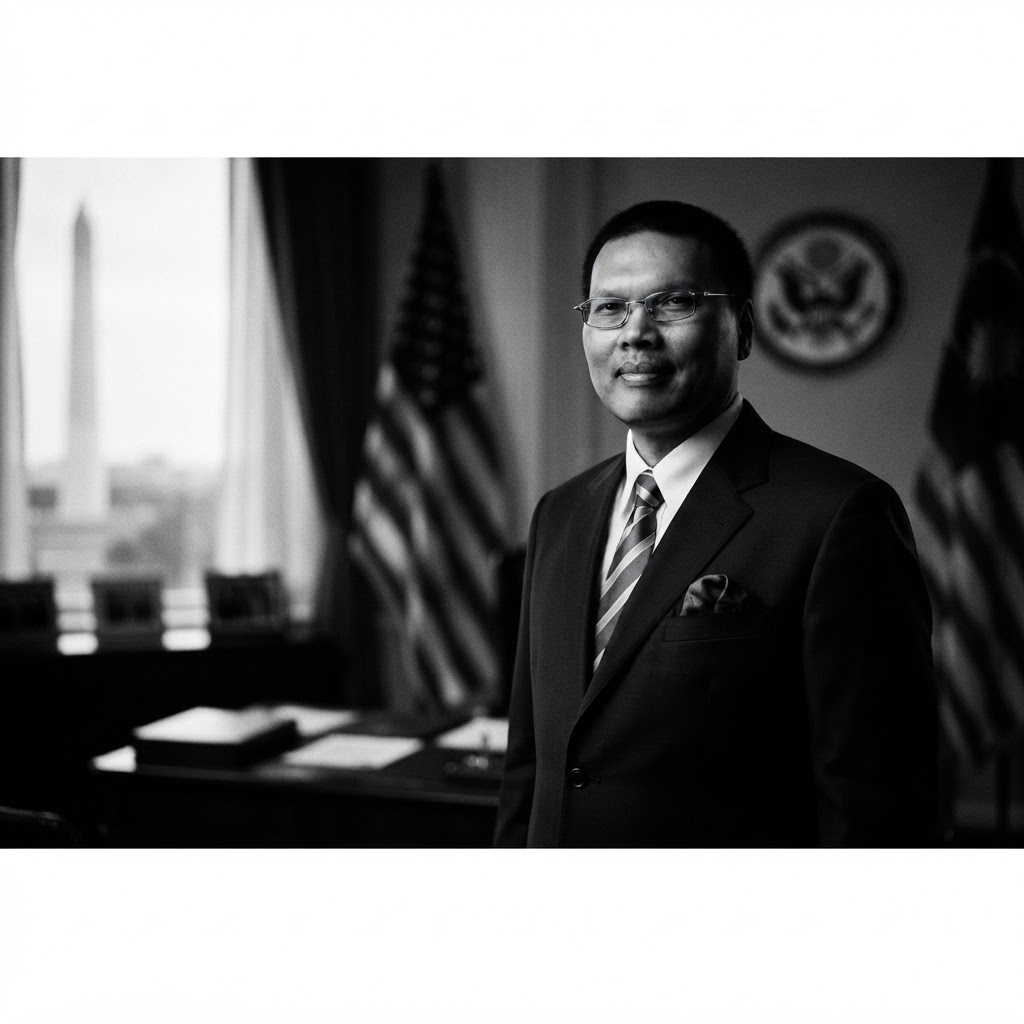
Six decades after Washington became the first country to recognise Malaysia's independence, its 18th Ambassador to the United States talks semiconductors, AI data centres, ASEAN diplomacy, and why Malaysia is a bridge between the West and the Global South.
A Six-Decade Partnership, at a Pivotal Moment
You presented your credentials in Washington last year as Malaysia's 18th Ambassador to the United States. What has struck you most about the relationship since you arrived?
This partnership, this relationship is very strong, very enduring. Since the establishment of our bilateral relations in 1957. The US, in fact, was the very first country to recognize our independence, on 31st of August 1957, and on the same day, the US also admitted us as a member of the United Nations. And then fast forward we established with the US a comprehensive partnership in 2014. And then fast forward again in 2024, we have established a comprehensive strategy partnership with the US. It is based on three pillars. One is the political security or geopolitics, if you will. Second is economic and trade. And the third pillar is the people-to-people contact. The US has been the largest source of FDI for Malaysia, cumulatively, and not less than 250,000 Malaysians have graduated from American institutions. And then we have very close defense cooperation. Every year, we conduct, between, you know, 12 to 15 bilateral military exercises. And it has not stood still either. We started out really as a trading relationship, rubber and tin going out, and now we are part of a high-tech ecosystem. On the investment side, it is not just manufacturing anymore, we are talking advanced semiconductor packaging, AI data centres, digital infrastructure, and in recent times we have had very significant commitments from companies like IBM, Google, Intel and Amazon Web Services. On the defence side, those exercises I mentioned, they are not just for show, I would say, they cover maritime domain awareness, cybersecurity and disaster response. And on the people side, it is moving from simply sending students to what I like to call brain circulation, working together on green energy, biotechnology and AI research.
Since arriving in Washington in 2025, what have your top priorities been?
My mandate has been very clear, I would say. Economic diplomacy, that is at the very top. The US is looking to diversify and secure its supply chains, particularly in semiconductors and other critical technologies, and my job is to make sure Malaysia remains the partner of choice. So I spend a lot of my time, not only with policymakers here in Washington, but with corporate leaders across the US, to bring high-value investment into our digital economy. My second priority is regional diplomacy. Malaysia has been very active within ASEAN, and I have worked to keep the US-ASEAN dialogue constructive, because we share the same vision, a free, open and prosperous Indo-Pacific. And then finally, I am looking at modernising our bilateral framework itself, cybersecurity, the green technology transition, and continuous workforce development, so that this six-decade partnership is ready for the next sixty years.
With these six decades of deepening relations between the two countries, what do you see as the defining opportunity for the next decade?
The next decade is cooperation. I mean, we will continue to strengthen the existing cooperation, but we are also looking at a new frontier with technology. Of course, you're aware right now that we are all talking about artificial intelligence, we're talking about something related to cybersecurity and also green technology. If you look at the Kuala Lumpur ASEAN Declaration 2045. This is where Malaysia, when we chaired ASEAN in 2025, that we, together with the other 9 ASEAN countries, now 10, with the inclusion of Timor-Leste, have identified the area of cooperation that Malaysia is part of. In a year defined by profound geoeconomic flux and major power rivalry, Malaysia's chairmanship kept ASEAN unified and focused on tangible outcomes rather than ideological divides. When Malaysia assumed the ASEAN Chairmanship in 2025, we were stepping up during a period of acute global anxiety regarding supply chains and major power rivalry. Our guiding theme was 'Inclusivity and Sustainability' and we meant that in both economic and diplomatic terms. The primary signal we wanted to send to Washington, and indeed the world, was that ASEAN remains cohesive, functional, and central to the Indo-Pacific architecture. Our core theme drove concrete actions, from advancing the Enhanced ASEAN Power Grid to formalizing Timor-Leste's integration into the bloc. The reception in Washington was highly constructive, at the ASEAN-US Summit in October 2025 there was a clear recognition from the U.S. leadership that a Malaysia-led ASEAN is a force for regional stability.
Malaysia as a Destination for American Capital
A growing number of American multinational companies continue to choose Malaysia, sometimes instead of, sometimes alongside its neighbors. But from where you sit in Washington, what's driving that appetite?
Malaysia provides a very conducive environment for American investors. We have the human resources. Highly educated, English-speaking people. We have a very consistent policy with regards to foreign investment. And we also provide certain incentives to foreign investors. So these are the three, I would say, attractive elements that Malaysia offers to American companies, not just to start their investment in Malaysia, but also to continue, to give more focus on Malaysia in terms of investment in the long term. And I should say, Malaysia is not new to this. Companies like Intel, Texas Instruments, Micron, they have been operating in our country for decades already. We anchor a critical portion of the world's semiconductor testing and packaging. But what excites me is where we are going next. Under our National Semiconductor Strategy, we are aggressively moving up the value chain, advanced IC design, and high-end packaging for AI chips. As of September this year, we have set a national target of $120 billion in semiconductor investment by 2030. So when American capital looks at this part of the world, I believe they see Malaysia as the most resilient and the most reliable node available to them.
And what role does the embassy play in connecting companies to opportunities in Malaysia?
We have always been reaching out actively to American companies. We have a couple of ways. We have American institutions here, for example, U.S. ASEAN Business Council. And we are also using the Malaysian diaspora here. Many Malaysians have lived in the U.S. for quite some time, and have got excellent connections with American companies here, and this is a great way for us to reach out to American companies in the US. And so far, it has been very effective. There is also the Asia Group, for example, and the American Chamber of Commerce. So, so there are many ways to expose what Malaysia can offer to American companies in the US. And of course, the Embassy does not work alone in this. Once a company is interested, we work hand-in-glove with our Ministry of Investment, Trade and Industry, MITI, and with MIDA, the Malaysian Investment Development Authority. I would describe MIDA as the bridge between business and government, they are the ones on the ground expediting approvals, navigating the tax incentives, helping with real estate, matching investors to local talent. So the Embassy is really the first door in Washington, and MIDA and MITI make sure that door leads somewhere.
Trade and Economic Ties — Building a Durable Framework
When you look at that trade arrangement between Malaysia and the U.S., without dwelling on the details, how would you characterize where things stand today?
At the moment, still electronics or semiconductors specifically are the largest pull between our countries. Malaysia exports 12% of the global semiconductor product. And Malaysia has become a crucial part of the value chain for semiconductors. Malaysia is the place where the ATP, the Assembly Testing and Packaging of semiconductors, happens. We are crucial in the value chain of semiconductors. Say, for example, Malaysia collapsed, for example, the whole global supply chain of semiconductors would collapse. I would say, in any economic partnership that goes back decades, there will be moments of recalibration, and the adjustments we saw over the last year were really the global economy moving toward a new reality, one that is more focused on supply chain security. Malaysia's approach was not to look backward, but to ask how we build something durable out of it. And that is really what led to the United States-Malaysia Agreement on Reciprocal Trade late last year, reciprocal market access, no discriminatory digital taxes, our environmental and labour standards aligned. It gives businesses, American and Malaysian, the certainty to plan and to invest. And beyond semiconductors, I would point to a few other sectors growing fast, critical minerals and rare earths, where under our new bilateral MOU we are positioning Malaysia as a processing hub, not just an extraction site, aerospace manufacturing, which has grown quietly but is now quite advanced, and agriculture, where we are streamlining our halal requirements so we can bring in more American food and agricultural products too.
That's astounding. So how does Malaysia think about balancing its economic relationships across the US, China, and the rest of ASEAN?
Malaysia, as well as other ASEAN countries, are balancing our relationship between the US and China. At the moment, the segments that US and China are active in our market are not competing, China is actually more in terms of consumer products, and the US more about technology in Malaysia, but I could see that the competition will be in the area of artificial intelligence eventually. This is really why I describe Malaysia as a neutral and a secure platform. We do not believe in choosing sides, we believe in rule of law, and strong protection of intellectual property, and that gives American companies the confidence that what they bring to Malaysia is safe with us.
Digital Economy, AI and Innovation
Malaysia is being positioned as a hub for data centers, for AI infrastructure, in Southeast Asia. How do you describe that opportunity to US technology companies?
Well, it's a huge opportunity, even as it is now. We have major American companies investing in Malaysia in data centers like Amazon, Google and Microsoft. They are investing a huge sum of money in Malaysia. We do not want American companies just investing in data centers though. In our negotiation with them, we also want them to train our people, linking them up with our institutions, for human resources, in Malaysia. I must say, American companies are not stingy with their technology transfer. If you look at many American companies which have started their investment in Malaysia, let's say — Intel, Microsoft, even Amazon — they always not just train Malaysians, but where local talent is good, American companies in the past had no hesitation to promote the local workforce to occupy senior positions in their companies. To give you a sense of the scale, our data centre capacity is expanding very fast, we expect it to go past 2 gigawatts by the end of this year. Johor has become the centre of this, 80% of the growth, because it has the power capacity, the land, and it sits right next to Singapore with direct subsea connectivity. We are talking about more than RM140 billion in approved investments in just a few years, and it is not only Johor, we are building hyperscale parks in Selangor, Cyberjaya and Penang too. And we are not only providing the land, Malaysian companies are providing the whole energy solution. YTL Power, for example, recently completed Malaysia's first Nvidia-powered AI data centre in Johor, and it runs on dedicated solar generation. On the American side, just to put numbers to what I said, AWS has committed $5.5 billion, Microsoft $2.2 billion and then further cloud expansions, Oracle $6.5 billion for AI and cloud computing, and Google is heavily invested too.
And on the talent side, how is Malaysia preparing its workforce for this digital economy?
This is something I think about a lot, because infrastructure alone does not sustain innovation, talent does. Our focus now is making sure Malaysia does not just host the data centres, but actually develops the AI products and applications that run inside them. Our studies show that 70% of the new jobs in our economy will be in digital technology and AI, so we are overhauling our workforce training. We are introducing what we call skill universities, working directly with industry, to give people rapid, high-level qualifications, cloud architects, prompt engineers, data scientists, the people the American hyperscalers will need tomorrow.
Tourism, Culture and People-to-People Ties
What do you think Americans are missing, if they do not visit Malaysia?
Our diversity, I would say. We are a multicultural society, we have the Malays, we have the Chinese, we have the Indians, amongst others, and our own very rich culture. When you talk about culture, it's not just a way of life, it's our food, the way we dress, and the way we behave. And these are the things that I think many tourists from the US, you know, have been missing. So you should come and visit us in Malaysia to see how we have been able to live in harmony, for so many decades. Tourism is more than 15% of our GDP now, it is very important to us, and the US is a high-yield market, a priority market, for Malaysia. We launched our Visit Malaysia 2026 campaign, the theme is Surreal Experiences, and really, tourism is the most joyful form of diplomacy, I like to say. When an American comes to Malaysia, they are not just on a holiday, they are seeing, living, a model of harmonious multiculturalism. And we know connectivity matters, so we are working with airlines on the trans-Pacific routes, more code-shares, easier access, and we are putting more effort into our visibility in the US market, digital campaigns, partnerships with American travel companies. We want Malaysia right at the top of the list when Americans think about this part of the world.
Tell us a little bit about the different parts of Malaysia and what it can offer tourists with different backgrounds, appetites, interests.
We have the Borneo Islands, Sabah and Sarawak, separated by the South China Sea. And if you want beaches, we can offer you beautiful beaches. If you want jungle trekking, we have it, both in the eastern and western parts of Malaysia. If you want to see naturally formed caves, we have the Mulu Caves in Sarawak, which are very interesting, and very beautiful, as well as incredible wildlife, we have the famous orangutans. Actually, it's very difficult to detail all that the Malaysia offering encompasses, but as our famous advertisement, you may remember, said, Malaysia is Truly Asia, and that's exactly what it is.
Beyond tourism, what role do the diaspora and alumni networks play in the relationship?
You cannot really look at the Malaysia-US relationship without looking at education. Over the decades, hundreds of thousands of Malaysians have studied at American universities, and today those same people are our CEOs, our technology leaders, our policymakers. So when Malaysian and American leaders sit down together, we already speak, I would say, the same cultural and business language, it builds trust immediately. Our diaspora here in the US is very accomplished too, and part of my job as Ambassador is to activate that network, not only as cultural representatives, but to help channel American innovation, research and capital back into Malaysia, what I like to call brain circulation. And we should not forget programmes like Fulbright, and the history of the Peace Corps in Malaysia, these have created what I would call lifelong ambassadors on both sides. Governments sign the treaties, but it is the people who really build the relationship.
Regional Leadership and ASEAN
How does ASEAN's trajectory factor into the bilateral relationship with the US?
I would say you cannot really separate the two, the Malaysia-US relationship and the wider ASEAN story, they reinforce each other. Malaysia has a credibility I think is quite unique, we are deeply embedded in the Global South, but we are also a top destination for Western capital and technology, and that lets us act as something of an honest broker in the region. During our chairmanship we worked to keep the lines of communication open on issues like Myanmar and the South China Sea, de-escalation and consensus, not division. Through things like the ASEAN Digital Economy Framework Agreement and our green transition work, we are knitting the region's economies closer together. We do not believe in blocs that exclude people, whether it is ASEAN-China talks on the South China Sea or American cloud investment, our approach is to bind the region together. Washington talks about a free and open Indo-Pacific, but the only way to get there without raising military tensions is through a strong, integrated ASEAN, so when Malaysia strengthens ASEAN, I believe that directly helps American interests here too. Now that the Philippines holds the chair, Malaysia will keep championing an outward-looking ASEAN, and I expect Washington to keep engaging us not only on security, but as a partner for digital innovation and clean energy.
A Personal Journey and a Vision for the Century
You've served as an ambassador to Qatar and Austria and you've been Malaysia's permanent representative to the United Nations. How has that path shaped your approach in Washington?
I also served here in Washington, DC, in the mid-nineties, almost 30 years ago, as the First Secretary of the Malaysian Embassy to the US, and I'm happy to be back here, because I can see the growth, and the strengthened partnership between Malaysia and the US. The US is important to everyone, and Malaysia is also very important to the US. If you look at it from the perspective of geopolitics, from the perspective of trade and investment, and from the perspective of technology, and of people-to-people contact, Malaysia is also important to the US. My time at the United Nations, in particular, taught me how to find consensus when there is a lot of friction at the table, many different interests all at once, and I think that helps me here in Washington, to navigate things with a steady hand. I do not believe in staying quiet and passive, I believe in constructive engagement, something that actually delivers results for both our countries.
Is there a misconception about Malaysia you would like to correct for an American audience?
Yes, I would say so. We are very proud of our natural beauty, our multicultural culture, and rightly so, but today's Malaysia is also powering the hardware of the global digital revolution, and I am not sure that side of us is always understood in Washington or on Wall Street. I want Americans to see Malaysia as a partner of real substance, a stable, English-speaking democracy, somewhere that protects intellectual property seriously, somewhere our multi-ethnic harmony is actually a source of economic strength, not just a nice story. And our non-aligned position, I want to be clear, that it is not us sitting on the sidelines, it is a deliberate choice, to be a bridge between the West and the Global South. We are not looking for headlines or friction, we want to deliver consistency and commercial trust.
What would success look like for you by the end of your posting here?
By the time my time in Washington is finished, I want to have pushed this relationship into something modern, future-proof, insulated as much as possible from the shifts in geopolitics. Concretely, that means three things, I would say. First, moving our cooperation into permanent, high-value framework agreements, artificial intelligence, advanced semiconductor supply chains, critical minerals. Second, making sure that when American policymakers think about their Indo-Pacific strategy, Malaysia comes to mind instinctively, as a trusted partner. And third, deepening the academic and brain circulation ties, so that the next generation of Malaysian and American leaders feel the same connection my generation has felt for decades. I want us to look back on this period not just as another chapter in sixty years of friendship, but as the moment the partnership really took flight for this century.

