Daud Vicary Abdullah
Managing Director, DVA Consulting
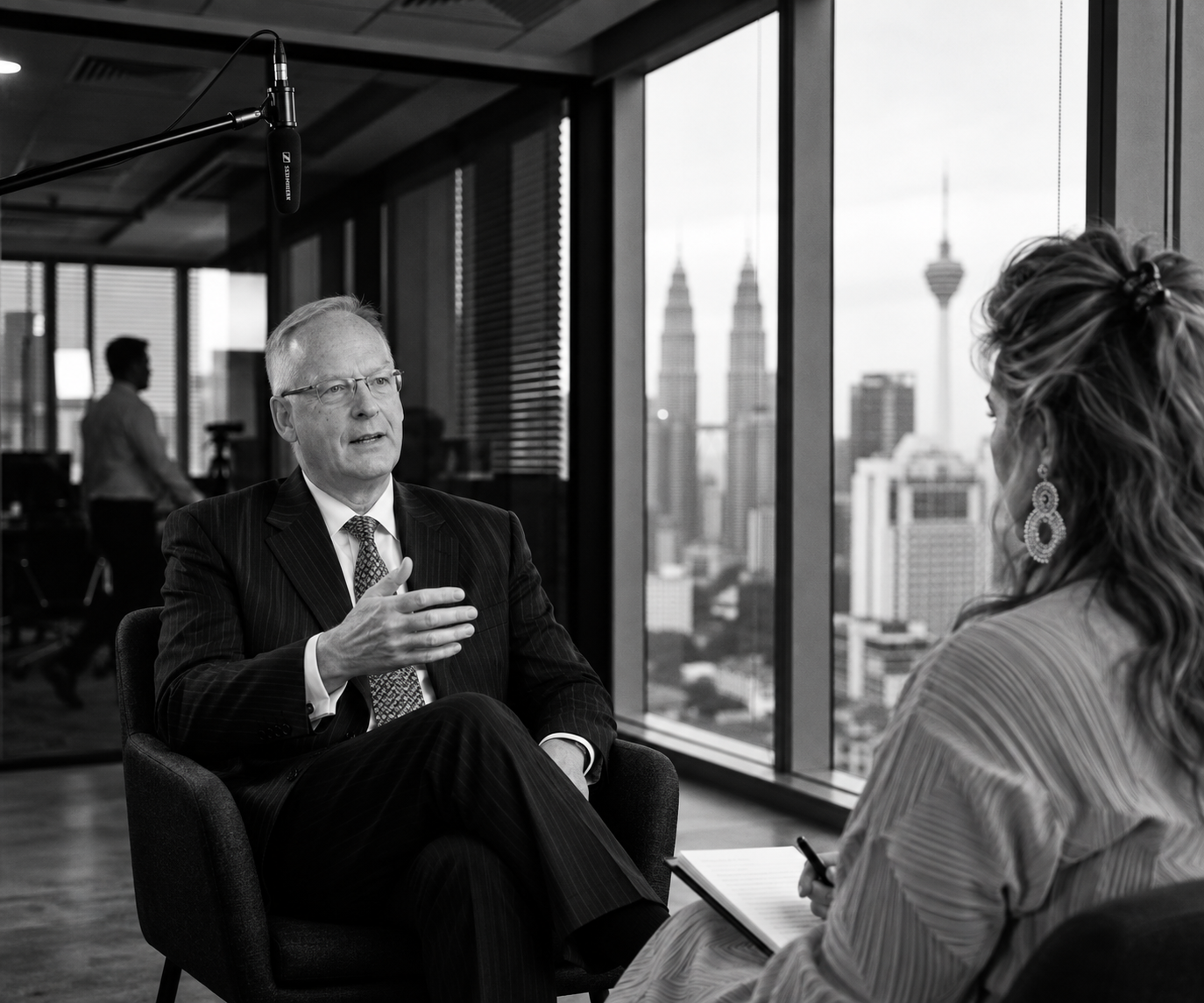
From leading Islamic banks in Malaysia to heading Deloitte's global Islamic finance practice, Daud Vicary Abdullah reflects on a career built in Kuala Lumpur — and on why the world's most ambitious investors are looking to Malaysia.
A Banker's Path from London to Kuala Lumpur
From leading Islamic banks in Malaysia, to heading Deloitte's global Islamic finance practice, to running INCEIF, which chapter of your career has been the most rewarding?
All have been equally rewarding. Each brought different experiences and allowed me to grow and develop as a leader.
You have made Kuala Lumpur your home for many years. What does Malaysia offer a professional from abroad that you could not easily find elsewhere?
Opportunity in Islamic Finance. A balanced lifestyle and a wonderful level of acceptance by the community.
What led you to establish DVA Consulting in 2008, and what kind of clients come to you today?
I decided to quit direct involvement in Banking and set up my own company to provide Advisory and Consulting Services in Islamic Finance as this was more in line with my skills and desire to help develop the IF Industry. Clients that come to me today usually want advisory in IF and Education on developments in the industry.
Malaysia — A Global Centre for Islamic Finance
Malaysia runs a dual system in which Islamic and conventional banks operate side by side under one regulatory framework. How has that benefited customers and businesses?
The clarity and robustness of the framework. Also, the depth and breadth of the development. Malaysia continues to lead on a global scale and continues to be a Thought leader in this space.
For an international institution setting up in Kuala Lumpur, what does that clarity and consistency mean in practice?
Fundamentally it is about knowing where you stand, what you can and cannot do and encouragement to push the envelope further.
A Sukuk Market of Global Standing
Malaysia is regularly counted among the world's leading sukuk markets. What makes it so deep and so attractive to issuers and investors alike?
Clear regulation. Understanding of the marketplace and a centre for innovation.
Malaysia has been a pioneer in green and sustainability sukuk. Why has this been such a natural fit, and what has it meant for the market?
There is a noticeably clear alignment between the objectives of the Maqasid al Sharia'á (which have been around for 1400 years plus) and the SDGs. The market has recognised this fit and Malaysia's leadership.
Global sukuk issuance reached a record level in 2025. Where do you see the next wave of growth for Malaysia's Islamic capital market?
In two areas. Firstly, the development of the Halal Supply Chain and secondly in digitisation and tokenisation of assets.
How should a U.S. institutional investor, such as a pension fund, an endowment, or an asset manager, think about sukuk as part of a diversified portfolio?
A balanced portfolio based on risk and return with diversified portfolio including Sukuk.
Ethical Finance for a Values-Driven Age
For an American reader meeting Islamic finance for the first time, how would you explain in a few sentences what makes it different?
With an explanation I have used successfully since 2005 (including a presentation to the FED in 2010): “Islamic Finance is about the efficient and effective mobilisation of capital for the benefit of the real economy.”
You have long said that ethics are integral to Islamic finance. How do those principles align with what today's investors call ESG or sustainable investing?
Ethical values are part of the Maqasid al Sharia'a. This is a natural alignment.
Instruments such as zakat, waqf and sadaqah are increasingly discussed alongside the UN Sustainable Development Goals. How can they be put to work for social impact?
They are already being put to work. Zakat funds have been used, for example, to assist in the alleviation of drought and famine in East Africa (See the IFRC Kitui project). Sadaqah or charitable giving is in constant use. Waqf (Endowment Funds) are being used to Fund education, health care and sustainable development projects (recent examples include the Ipoh Doughnut City project in Malaysia which won the 2024 UN Habitat award for sustainability).
Is Islamic finance only for Muslim customers and investors? What would you say to people of other faiths who are curious about it?
Islamic Finance is for everyone who cares about the application of values and sustainability. It is not just about the prohibition of interest (Riba), which is also forbidden in the other Ibrahimic faiths of Christianity and Judaism.
Educating the Next Generation of Islamic Finance Professionals
For a young American considering a career in finance, what would you say about Islamic finance as a field, and about studying in Malaysia?
Islamic Finance provides opportunity for growth and development in Finance. The use of technology to develop tokenised and digital products. In addition, the growth of the Halal Supply Chain (China, India, Brasil, Russia, and the USA are the five leading countries providing Halal goods to the Muslim world). As the supply chain becomes more expansive, and we are seeing this already through China's active engagement with the ASEAN bloc regarding Halal Logistics, the need for finance for working capital, trade finance and Insurance (Takaful) will only increase. As can be seen from recent developments in Indonesia the entire Halal supply chain will need to demonstrate end to end sharia'a compliance. That means Islamic Finance. To maintain any position in the halal market all providers will need to use Islamic Finance and Takaful as an essential requirement. There are plenty of places for study in Malaysia for IF. This includes INCEIF which is AACSB accredited (the same level as Harvard Business School) and is recognised as the leading postgraduate educational institution for Islamic Finance and Research in the world. Malaysia is cheap to live in, the climate and food are great, and it is easy to get educational visas.
Fintech and the Digital Future of Islamic Finance
You have been involved with a number of ventures at the intersection of Islamic finance and technology. What excites you most about the way fintech is changing the industry?
The ability to challenge the accepted norm and to change it for the greater good.
Advising the World's Investors: Perspectives from DVA Consulting
Without naming names, can you share an example of a foreign institution that successfully tapped Malaysia's Islamic finance ecosystem, and what made it work?
Numerous Financial Institutions, law firms, accountancy firms, and consultancy firms have leveraged the business opportunities being provided by the exceptional growth of IF. Key to the success is the clear regulatory framework and the ease of doing business.
Malaysia sits at a crossroads between Asian and Middle Eastern capital. How can international firms benefit from that position?
Malaysia has built a solid reputation in IF based on a sound regulatory framework and the depth of capabilities in the market. It is well positioned in ASEAN to link with the Gulf, China, BRICS countries, and the Americas. It's all about the expertise and the certainty of the marketplace.
A Message to American Investors and Businesses
If you had one message for the American investors and business leaders reading this report, what would it be?
Do not be shy or mislead. You could be missing some great opportunities.
Where do you see the greatest opportunity for U.S. financial institutions and fintech companies in Malaysia over the next five years?
In the growth of digitisation and tokenisation and the development of the Halal Supply Chain.

